The Problem with Reconstructing Incidents from Raw Footage
Greyfield Manufacturing — a contract manufacturer operating two facilities in the midwest, producing metal sub-assemblies for industrial equipment customers — had a process quality team that was effectively part-time investigators. Not by design, but because the volume of incidents, near-misses, and customer-reported quality deviations requiring documented root cause analysis had grown to the point where investigation consumed a meaningful portion of every quality engineer's week.
The investigation process looked roughly like this: an incident or quality deviation would be reported, typically through the facility's ERP-linked quality management module. A quality engineer would be assigned. They would conduct worker interviews, pull the relevant shift log entries, and then begin reviewing raw camera footage from the facility's 32-camera NVR system. The footage review was the time sink. Finding the relevant camera, identifying the approximate time window, watching through footage at 2x speed while trying to reconstruct a sequence of events that no one had structured data about — that process averaged between 2.5 and 4 hours per investigation before a timeline could be drafted. The timeline then required review and approval before a corrective action could be formally documented.
Total elapsed time from incident report to closed corrective action: typically 5.5 to 8 hours, spread across one to three calendar days when calendar scheduling and shift coverage constraints were factored in. For a facility running 15 to 20 documented investigations per month, that represented a substantial quality team overhead that scaled with incident volume rather than with the complexity of individual events.
What an Operational Incident Timeline Changes
The structured event log that a zone intelligence system generates changes the investigation starting point from "a timestamp in a shift log" to "a pre-organized evidence package indexed by event type, zone, and time."
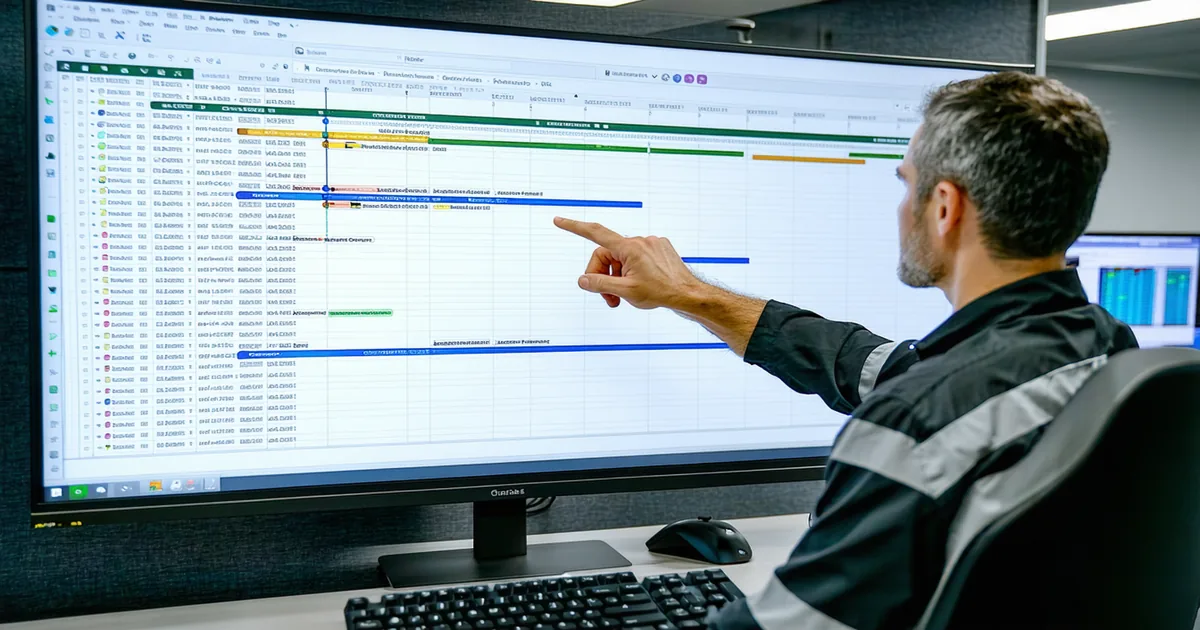
When an incident is reported in a facility running operational incident monitoring, the quality engineer's first step is not reviewing raw footage — it is opening the event log for the relevant zone and time period. The event log contains: every detected deviation in the zone during the period preceding the incident (an unoccupied station, a PPE non-compliance event, a density exceedance in the adjacent corridor), the equipment state at the time of each detected event, and direct links to the annotated video clips for each event. The clip is not raw footage — it is a trimmed, annotated segment centered on the detected event, with the detection overlays showing what the system identified and when.
For the quality engineer, that evidence package reduces the investigation start time from "several hours of footage review" to "10 to 15 minutes reviewing pre-indexed events." The work that remains is interpreting the evidence and drafting the corrective action — the cognitive work that requires a human, not the retrieval work that the system can do automatically.
What the Numbers Looked Like After Deployment
At Greyfield's primary facility — a 95,000 square foot operation with 14 active production zones — deploying operational incident monitoring and building the event log into the quality investigation workflow produced a measurable change in investigation time within the first month of operation.
Average time from incident report to completed investigation timeline: reduced from 5.5 hours to 38 minutes. Not for every investigation — complex events with multiple contributing factors still required more time — but for the 60-70% of investigations that involved a single detectable contributing event in a camera-covered zone, the pre-indexed evidence package eliminated the footage review step almost entirely.
Monthly quality team hours consumed by investigation overhead: reduced from approximately 140 hours to 45 hours. The remaining 45 hours reflects the irreducible cognitive work — interpreting evidence, drafting corrective actions, coordinating with supervisors, submitting to the QMS — plus the investigations involving events outside camera coverage or requiring extended root cause analysis beyond what the event log contained.
A secondary effect: the quality of corrective actions improved. When the investigation timeline is built from reconstructed memory and partial footage review, the root cause analysis tends to converge on the most visible contributing factor rather than the full causal chain. When the event log shows three preceding events in the 20 minutes before the incident — a PPE non-compliance, a density spike in the adjacent corridor, and a forklift transit through a zone that was supposed to be pedestrian-only — the corrective action addresses all three rather than the one that the investigator happened to notice while reviewing footage at 2x speed.
The Integration with the QMS
Greyfield was running a QMS (Quality Management System) built on a platform common in mid-size contract manufacturing — a combination of an ERP-linked non-conformance module and a shared document management system for corrective action records. The operational incident monitoring system's event log did not replace any part of that QMS. It fed into it.
The practical integration was straightforward: when the quality engineer opens a non-conformance in the QMS, there is a field for "supporting evidence." Previously, that field was populated with screenshots from raw footage and manually written observation summaries. After deployment, it is populated with exported event log entries and direct links to the annotated clips stored in the monitoring system. The corrective action document generated in the QMS references the event log data as its evidentiary basis.
This integration required no custom software development — the event log export format was a standard CSV with clip references, and the QMS link field accepted document references. Connecting the two systems was a process change, not a technical integration project.
What Didn't Change, and Why That Matters
We are not saying that operational incident monitoring automates the investigation or eliminates the quality team's role. It doesn't, and it shouldn't. The value of a skilled quality engineer is in their ability to read a set of evidence and draw the correct causal inference — a task that requires understanding the production process, the equipment behavior, and the organizational context in a way that a detection system does not possess.
What the monitoring layer removes is the retrieval burden: the hours spent finding, scrubbing, and organizing evidence that the system can index automatically. That retrieval burden was consuming 65-70% of total investigation time at Greyfield. Removing it did not change the quality of the engineering judgment applied to the evidence — it gave the engineers more time to apply that judgment to more investigations, or to spend more time on the high-complexity events that genuinely required extended analysis.
There is also a consistency benefit. When investigations are conducted under time pressure with incomplete evidence, there is natural variation in investigation quality across events and across investigators. A structured evidence package that is produced automatically for every event in a covered zone reduces that variation — not by standardizing the judgment, but by standardizing the evidence quality the judgment is applied to.
Scaling the Approach Across Multiple Facilities
After the primary facility deployment demonstrated measurable investigation time reduction, Greyfield extended the deployment to their second facility — a smaller 60,000 square foot operation running eight production zones. The extension took approximately two weeks, including the zone definition session, camera connectivity verification, and QMS integration configuration. The investigation time improvement at the second facility was comparable: average time from incident report to completed timeline reduced from 4.5 hours to 32 minutes for events within camera coverage.
The multi-facility pattern raised a management reporting question that the single-facility deployment had not surfaced: how do you compare safety and quality performance across facilities when the evidence base is different? With event logs from both facilities running in the same monitoring platform, the operations director could, for the first time, compare the distribution of near-miss event types between facilities on a consistent measurement basis — not relying on the differing reporting cultures of two facility management teams, but on what the camera systems were actually detecting. That cross-facility visibility is a capability that neither manual investigation logs nor isolated CCTV systems can provide.