What CCTV Actually Does — and What It Doesn't
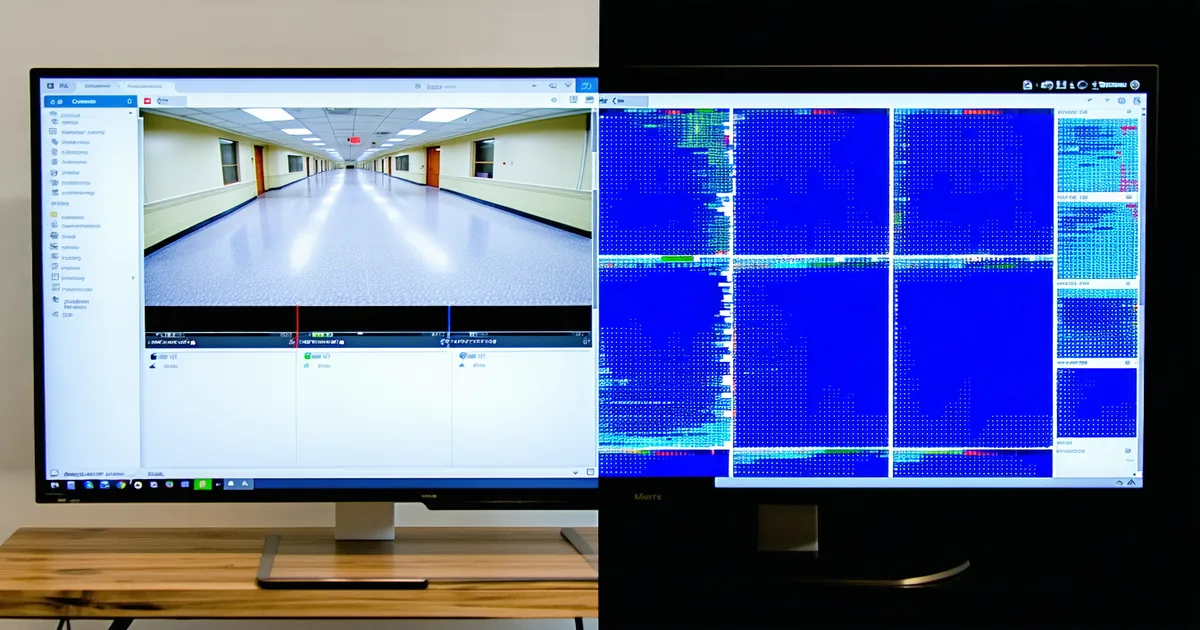
Security camera systems in industrial facilities perform one core function reliably: they store video footage. That footage is retrievable after an event, usable as evidence in an incident investigation, and available for manual review when someone has a specific question to answer. CCTV does this job well. After three decades of adoption in industrial environments, the technology is mature, the integration with VMS platforms like Milestone XProtect and Genetec Security Center is well-understood, and the operational cost of a well-maintained camera network is predictable.
What CCTV does not do is watch. The footage is recorded, but the operational intelligence embedded in that footage — the pattern of forklift activity in a receiving zone over a 10-hour shift, the frequency of PPE compliance events across three production areas, the correlation between worker density in a staging lane and downstream throughput delays — is inaccessible without a human reviewing the footage, or a system doing it computationally.
That gap between recording and analysis is where the 80-minute incident detection delay comes from. Not from equipment failure or system malfunction. From the basic reality that no one was watching in real time, because watching in real time — across all cameras, without interruption — is not a task that human operations teams can sustain.
The Structure of the Data Gap
Understanding why the data gap matters requires being specific about what information a zone intelligence system generates that a CCTV archive does not contain.
A CCTV archive contains: continuous video recordings, indexed by camera and timestamp, stored until retention limit. That is it. Retrieving anything from that archive requires knowing what you're looking for, knowing approximately when it occurred, and manually reviewing footage from the relevant camera for the relevant period.
A zone intelligence system operating on the same camera feeds generates, continuously and automatically: a timestamped event log of every detected deviation from configured baseline conditions, organized by zone; occupancy and density metrics per zone across the shift; equipment utilization timelines derived from visual state observation; PPE compliance rates per zone per shift; and alert notifications for configured threshold exceedances, delivered in real time.
The same video data produces radically different operational utility depending on whether it is merely stored or actively processed. The CCTV archive contains the answer to the question "what happened in Zone 4 during the second hour of afternoon shift on Tuesday?" A zone intelligence system answers that question automatically, before you know to ask it.
Why Detection Latency Is an Operational Cost, Not Just a Safety Metric
The 90-second alert threshold that zone intelligence systems are designed to meet is most often discussed in safety contexts — 90 seconds from a safety deviation to a supervisor notification is meaningfully different from an 80-minute discovery delay. But detection latency has operational costs that go beyond safety incidents.
Consider a production bottleneck scenario. An assembly station on the main production line goes offline — an operator leaves the station for a medical issue, a jig breaks and the operator stands waiting for maintenance — and the downstream buffer begins filling. In a CCTV-only environment, the first signal that something is wrong typically comes from a downstream production rate drop that appears in the shift log 20 to 30 minutes after the upstream station went offline. By that point, the buffer has overflowed into adjacent staging space, the downstream operators have begun unscheduled pauses, and the throughput loss for the shift is already measured in hours.
In a zone intelligence environment, the unoccupied assembly station triggers an alert within 90 seconds of the operator departing. The supervisor is notified while the downstream buffer is still manageable. The intervention — routing another operator to cover, dispatching maintenance, adjusting the line pace — happens before the cascade has developed. The throughput impact is minutes, not hours.
This is not a hypothetical scenario. It is the operational pattern that makes zone intelligence a production management tool as well as a safety monitoring tool. The same detection capability that catches a PPE violation in under two minutes also catches an unoccupied critical station, an equipment idle event, or a density buildup in a bottleneck zone — and does it continuously, without requiring a supervisor to be watching the right camera at the right moment.
The Counterargument: Is Active Monitoring Worth the Complexity?
The case against zone intelligence over traditional CCTV typically takes one of two forms. The first is cost: the upfront investment in a computer vision system and the ongoing operational overhead of managing alert queues and rule configurations adds cost that a CCTV-only system doesn't incur. The second is false positive fatigue: if a zone intelligence system generates too many alerts, supervisors stop responding to them, and the detection advantage disappears in practice.
Both concerns are legitimate. The cost argument is a straightforward ROI calculation — the value of the incidents prevented and the investigation time saved must exceed the cost of the deployment and its ongoing management. This is not a calculation that every facility will resolve in favor of deployment; facilities with low incident rates, strong manual supervision, and limited camera coverage may genuinely not find the economics compelling.
We are not saying that every industrial facility should deploy zone intelligence over traditional CCTV. We are saying that the data gap between recording and analysis has a measurable operational cost, and that the decision to continue bearing that cost should be made consciously rather than by default. The right question is not "do we need zone intelligence?" but "what does the data gap cost us per year, and how does that compare to what addressing it would cost?"
The false positive fatigue concern is a system configuration quality issue rather than an inherent limitation of the technology. A zone intelligence system with poorly tuned detection rules will generate excessive alerts. A system with rules calibrated against the actual operating conditions of the facility — validated during an initial deployment period and adjusted based on operator feedback — generates an alert queue that supervisors can act on without experiencing alert fatigue. The difference is in the deployment and onboarding quality, not in the technology category itself.
The Practical Transition: What Doesn't Change
Deploying zone intelligence on top of an existing CCTV infrastructure does not require replacing or decommissioning the CCTV system. The existing VMS continues to function as the primary video storage and retrieval layer. The zone intelligence system connects to the same camera feeds — via RTSP/ONVIF, or through an integration with the VMS — and processes the streams for operational intelligence, while the VMS continues managing recording, retention, and access control.
This additive architecture means that the evidence use case for CCTV — retrieving footage for incident investigation, insurance claims, and OEM audit requests — remains intact. Zone intelligence adds a structured, indexed event log that makes those retrievals faster and more targeted, but it does not remove the capability that the CCTV system was originally deployed to provide.
For facilities that have invested in a mature Milestone or Genetec deployment, the transition is a capability expansion rather than a replacement decision. The existing camera infrastructure, the existing VMS, and the existing storage and retention infrastructure all continue serving their original purpose. What changes is that the continuous video data those systems generate starts producing operational intelligence in real time, rather than being available only for retrospective review after an event has already occurred.
Measuring the Gap in Your Facility
The most reliable way to understand what the data gap is costing a specific facility is to measure two things: the average time between when a detectable operational deviation occurs and when the operations team becomes aware of it, and the downstream cost of that detection delay in production impact, investigation time, or regulatory exposure. For most mid-size manufacturing and distribution facilities, that exercise produces numbers that are larger than the operations team expected, for the simple reason that undetected deviations are, by definition, not counted in any existing record.