The Compliance Verification Problem in Food Processing
HACCP — Hazard Analysis and Critical Control Points — is the risk management framework that governs food safety in US food processing facilities under FDA Food Safety Modernization Act (FSMA) requirements and USDA FSIS regulations for meat and poultry operations. Within any HACCP plan, Critical Control Points (CCPs) are the specific stages in the production process where control measures are applied to prevent, eliminate, or reduce food safety hazards to acceptable levels.
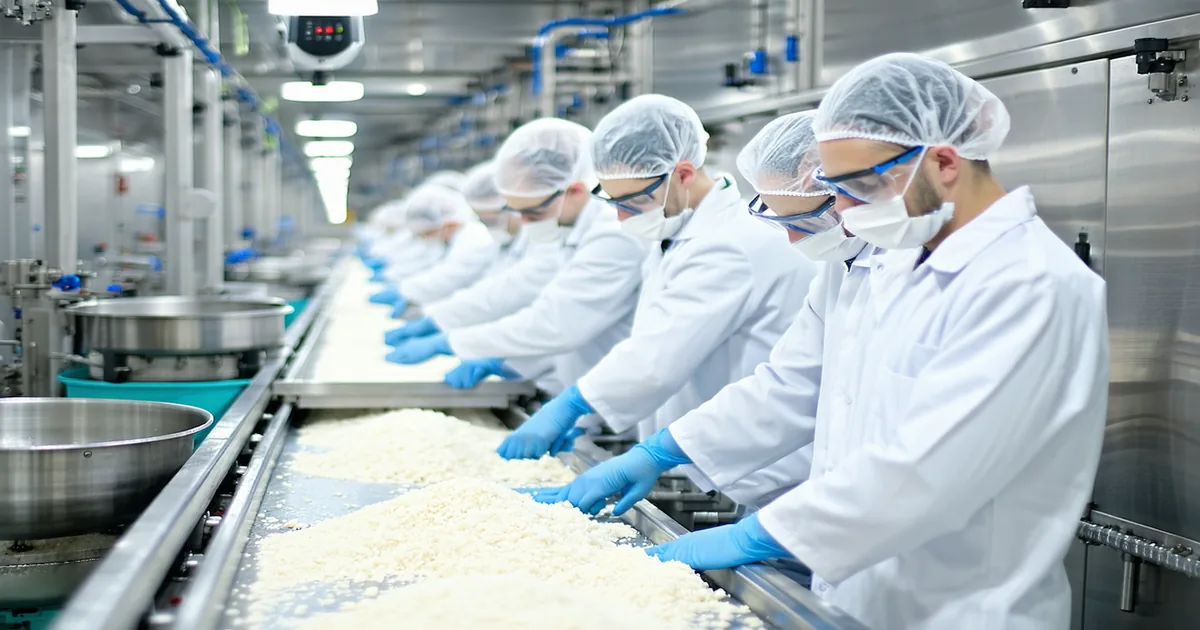
For many food processors, the PPE requirements tied to HACCP zones function as prerequisite programs — not CCPs themselves, but supporting controls that establish the hygienic conditions a CCP depends on. In a ready-to-eat (RTE) processing environment, for example, the requirement that workers entering the RTE zone wear hairnets, gloves, and sanitized aprons exists because contamination introduced through worker contact is a biological hazard that the downstream process steps may not be designed to eliminate.
The problem is that verifying PPE compliance across a shift — continuously, not just at the start of shift inspection — is labor-intensive in a way that scales poorly with facility size. A spot-check approach, where supervisors conduct compliance walkthroughs at periodic intervals, is standard practice but has well-documented coverage gaps: it captures compliance status at the moment of the walkthrough, not the average compliance state between walkthroughs. Workers who know when the supervisor typically walks through a zone respond to that knowledge. Workers who know they might be observed at any moment during the shift respond differently.
What HACCP Zone Monitoring Actually Requires
Before evaluating any automated PPE detection system, food processing operations managers need to be clear about what they are trying to verify and what regulatory documentation those verifications support.
The relevant FSMA framework is 21 CFR Part 117 (Current Good Manufacturing Practice, Hazard Analysis, and Risk-Based Preventive Controls for Human Food). Under 21 CFR 117.10, the personnel hygiene requirements include, among other provisions, that persons working in direct contact with food, food-contact surfaces, and food-packaging materials conform to hygienic practices while on duty. The associated requirement in 21 CFR 117.8 is that equipment and utensils are appropriately designed, maintained, and cleaned to minimize the potential for contamination — a requirement that depends on personnel maintaining the hygienic practices that the CGMP program specifies.
Regulatory documentation requirements under FSMA mean that food processors must maintain records demonstrating that their food safety plan is being implemented as designed. For personnel hygiene controls, this typically means written records of training, inspection logs, and corrective action records for observed violations. Automated PPE monitoring can generate a continuous compliance log that functions as a more complete record than periodic inspection logs — provided the system is configured to generate the specific output that corresponds to the compliance documentation the facility's HACCP plan requires.
Practical Considerations for Automated PPE Detection in Food Environments
Camera Placement and Sanitary Design
Food processing facilities operate under sanitary design requirements that affect where and how camera infrastructure can be installed. In high-care and high-risk zones — areas where exposed RTE product is handled — IP cameras and supporting cable runs need to be positioned to avoid creating harborage points for biological contamination and to be accessible for cleaning. Overhead camera mounts with smooth, non-creviced housings are the standard approach in these zones; bracket-mounted cameras that create horizontal surfaces or enclosed spaces that cannot be accessed for cleaning are problematic under Good Manufacturing Practice requirements.
This is a practical constraint that should be raised with the camera equipment supplier and the food safety team before any deployment plan is finalized. A computer vision platform vendor who is not familiar with sanitary design requirements for camera installation in food processing environments is a vendor who should be asked directly how they have addressed this in previous food industry deployments.
Hairnet and Glove Detection: What the Technology Can and Cannot Do
PPE detection in food processing environments presents different technical challenges than in manufacturing environments where hard hats and hi-vis vests are the primary detection targets. Hard hats and hi-vis vests are large, distinctively colored items that current computer vision models detect with high reliability. Hairnets and gloves are smaller, lower-contrast items that require higher camera resolution, better lighting conditions, and closer viewing angles to detect reliably.
Before deploying any PPE detection system in a food processing environment, operations teams should ask the vendor for specific detection performance data on hairnet and glove detection — not just hard hat detection, which is much easier. Performance benchmarks should be requested for the specific camera resolution and installation distance that matches your facility's conditions. A system that achieves 92% detection accuracy for hard hats at 8 meters may achieve 65% accuracy for hairnet compliance at the same distance under the same conditions. For a HACCP prerequisite control, 65% detection accuracy generates a false sense of compliance coverage that is potentially worse than no automated monitoring at all.
This is not a reason to avoid automated PPE detection in food processing environments. It is a reason to calibrate deployment expectations honestly against the technical capability of the specific system being deployed, in the specific camera conditions of the facility.
Integration with Food Safety Documentation Systems
Many mid-size food processors maintain their HACCP documentation in a combination of paper records, shared drive documents, and a food safety software platform (SafetyChain, Alchemy, or equivalent systems are common in the US market). For automated PPE compliance logs to be useful as regulatory documentation, their output format needs to align with what these systems expect — or be exportable in a format that the food safety team can incorporate into their existing record structure.
A compliance log that generates a daily CSV showing detected violations by zone, time, and event type is straightforward to incorporate into most documentation systems. A compliance log that stores events in a proprietary format accessible only through the vendor's dashboard, without an export capability, creates a documentation dependency that may not satisfy an auditor who wants records in the facility's primary food safety documentation system.
The Spot-Check Problem: A Concrete Example
Consider a ready-to-eat deli products facility in Texas running three shifts, with an RTE packaging zone that requires hairnets, gloves, and sanitized aprons for all personnel. The facility conducts supervisor compliance walkthroughs at the start of each shift, at the 3-hour mark, and at the 6-hour mark — three inspections per shift, per zone. Those three inspections consume approximately 45 minutes of supervisor time per shift and generate a log showing compliance status at three points in time.
Deploying continuous PPE monitoring on the four cameras covering the RTE packaging zone for a 30-day baseline period produced results that the spot-check data had not reflected: compliance rates measured between walkthroughs were consistently 8 to 12 percentage points lower than compliance rates measured during walkthroughs. The pattern was concentrated in the hour before the scheduled walkthrough time, suggesting that workers were aware of the inspection schedule and adjusting their behavior accordingly. This is a well-documented phenomenon in audit environments and it has a specific name in safety management literature — audit-time compliance bias — but it cannot be measured without continuous monitoring data to compare against scheduled inspection data.
The finding allowed the facility to adjust both the walkthrough schedule (making it irregular rather than predictable) and the physical layout of the gowning area (adding a secondary glove station that workers were bypassing during busy production periods). Both changes addressed real compliance gaps that the spot-check documentation had not surfaced.
What Automation Changes — and What It Doesn't
We are not saying that automated PPE detection replaces the judgment, training, and management culture that underpin genuine food safety compliance. It doesn't. A facility that uses automated monitoring to generate compliance scores but fails to act on the violations it detects is not a safer facility — it is a facility with better documentation of its safety failures.
What automated detection changes is the coverage, consistency, and timeliness of the information available to the operations team. The supervisor who previously knew compliance status at three points per shift now knows it continuously. The food safety coordinator who previously reconstructed a compliance history from inspection logs for an auditor now has a continuous event log. The corrective action for a specific zone's compliance trend is based on data collected over four weeks, not on three inspections per shift that may or may not have captured the problem period.
Used as an information source that supplements the judgment and oversight of a competent food safety program — rather than as a substitute for that program — automated PPE monitoring addresses a genuine gap in how food processing facilities currently measure and document personnel hygiene compliance.